Jun 4, 2026
Using Server Side events
Brief explanation of how does server side events work, and a little implementation.
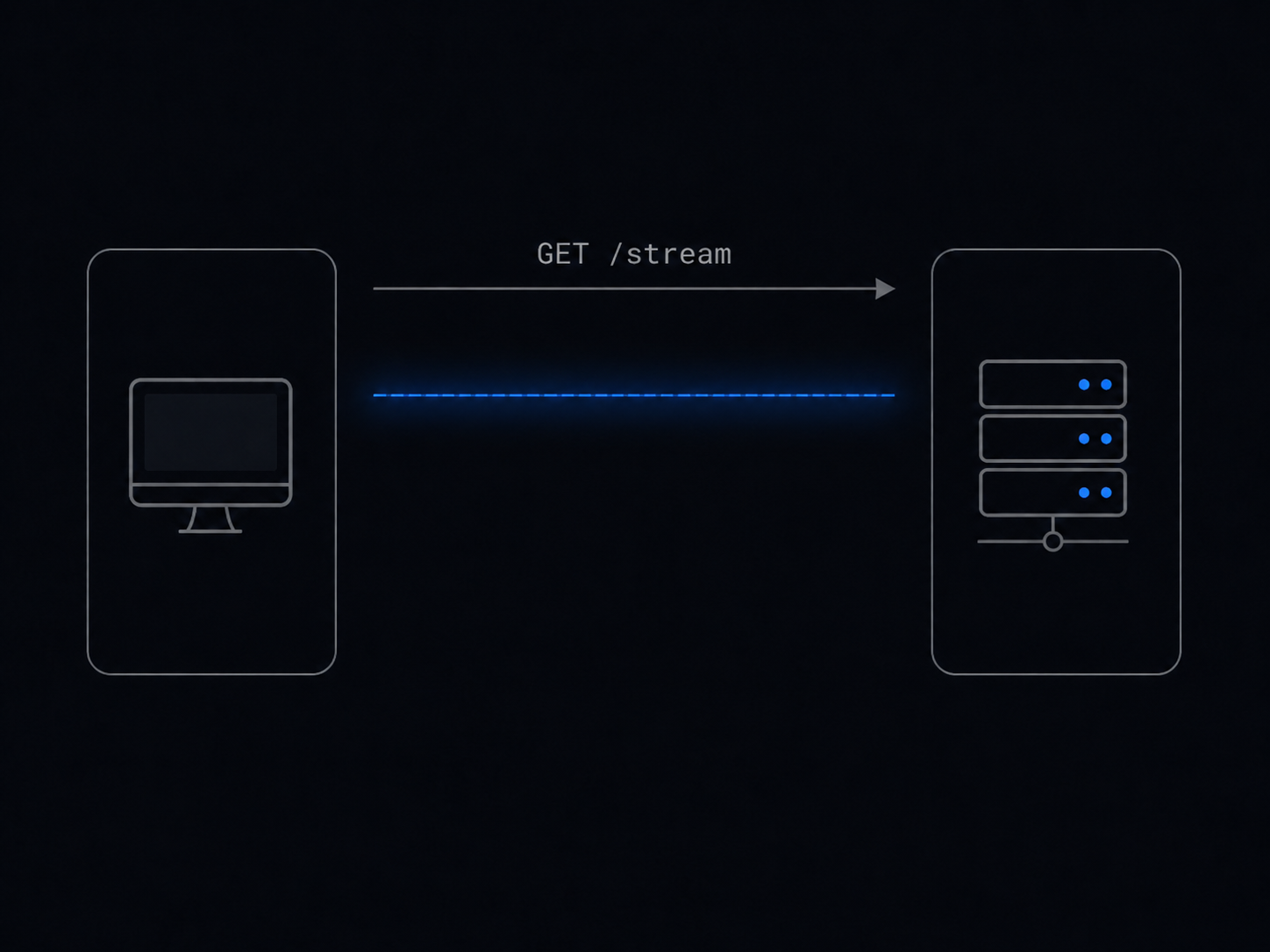
Hi, today we are going to talk about a subject that I have recently discoverd, Server Side Events… But first.
Why?
Have you ever need any real time update? there are some ways to implement this real time behavior, and not
they are not making a GET request per second… One of this ways is and yes you guess… websockets (okay maybe not funny), but another one it’s actually
server side events, which we will cover in this entry.
How do they work and what makes them real time?
Well, server side events or SSE work by making only one request… a simple GET that in this case, will persist.
    flowchart LR
    Browser[Client] -->|opens connection| Server[Server]
    Server -->|event: notification| Browser

    style Server fill:#111827,stroke:#ff8fab,color:#ffffff
    style Browser fill:#0f172a,stroke:#8bd3dd,color:#ffffff
The server and the user keep the connection, and make the request a stream of data, that in real time (updated by the server)
return events, that are received by our client. No more needed, just a single request, and a listener to that request.
Quick differences between websockets
- It is unidireccional, server sends, client listen
- Keeps the standar HTTP protocol
- It usually has previous logic around automatic reconnection
How can we implement them?
It is actually not that complicated, there are many patterns already written that we can follow.
First as following the patterns, we must follow the next steps:
- Return a
Content-Type: text/event-stream - Keep the connection alive
- Push or make a flush of the data in the following format:
data: <event>\n\n
# For python we will use FastAPI
import asyncio
import json
from fastapi import FastAPI
from fastapi.responses import StreamingResponse
import uvicorn

app = FastAPI()

async def event_generator():
    """Simple generator of events."""
    n = 0
    while True:
        payload = {
            "event" : n
        }
        yield f"data: {json.dumps(payload)}\n\n"
        n+=1
        await asyncio.sleep(2)

@app.get("/stream")
async def sse_stream():
    return StreamingResponse(event_generator(), media_type="text/event-stream")

if __name__ == "__main__":
    uvicorn.run(app, host="0.0.0.0", port=8000)
// Here we use simple http, but the implementation with frameworks like gin is
// about as simple.
package main
import (
"encoding/json"
"fmt"
"log"
"net/http"
"time"
)
type StatusPayload struct {
Event int `json:"event"`
}
func sseHandler(w http.ResponseWriter, r *http.Request) {
w.Header().Set("Content-Type", "text/event-stream")
w.Header().Set("Cache-Control", "no-cache")
w.Header().Set("Connection", "keep-alive")
// This checks whether the response writer supports streaming.
flusher, ok := w.(http.Flusher)
if !ok {
http.Error(w, "streaming not supported", http.StatusInternalServerError)
return
}
ticker := time.NewTicker(2 * time.Second)
defer ticker.Stop()
n := 0
for {
payload := StatusPayload{
Event: n,
}
data, err := json.Marshal(payload)
if err != nil {
http.Error(w, "failed to encode event", http.StatusInternalServerError)
return
}
if _, err := fmt.Fprintf(w, "data: %s\n\n", data); err != nil {
return
}
flusher.Flush()
n++
select {
case <-r.Context().Done():
return
case <-ticker.C:
}
}
}
func main() {
http.HandleFunc("/stream", sseHandler)
log.Println("SSE server listening on http://localhost:8080/stream")
log.Fatal(http.ListenAndServe(":8080", nil))
}As you can see the idea is the same, we set the right response header, and we push data throug the time without closing the connection.
You can test this by just making a simple: curl -N http://localhost:8000/stream
Or using almost any client of APIs of your preference.
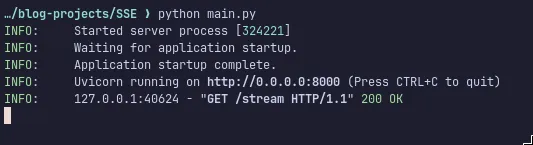
If you execute this, you will start watching this on your terminal or IDE:
- Server
- Client
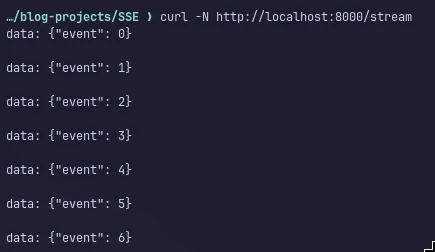
And well, beside of the bad quality of my screenshots, and the fact, that I do not have any interactive post where you can see this working in this page (sorry maybe some day), you can see the point, only one request needed, multiple data sent to our client.
You can have fun with those pieces of simple code, to make whatever you want, you could implement a notification system for your app, or a bad implemented message app by just making a trigger for those notifications. There are unlimited posibilities.
Considerations
As you read in the go example, we check if the flush was supported, since this is a key piece of the code, you can have many architectures on your software, so there will be some times, when implementing this is not as straight forward as the examples, for example, if you have any intermediary between the sever and the client, and the intermediary waits until the request is answered, you may need to implement some rules to skip on this endpoint, because this will hold all the events making the client not to receive anything, until it cancel the request, and when client does that, it will also not see anything.
sequenceDiagram
    autonumber
    participant Client as Client (Browser/App)
    participant Proxy as Intermediary (Proxy/LB)
    participant Server as Go SSE Server

    Client->>Proxy: GET /stream (Accept: text/event-stream)
    Proxy->>Server: Forward GET /stream

    Server-->>Proxy: Headers (Content-Type: text/event-stream)
    Server-->>Proxy: data: {"status": "en_movimiento"} \n\n (Flushed)
    Note over Proxy: Intermediary holds data in memory,<br/>waiting for the server to finish the request.

    Server-->>Proxy: data: {"status": "llegada"} \n\n (Flushed)
    Note over Proxy: Still buffering...

    Client-xProxy: Cancels request (Timeout / Frustration)
    Proxy--xClient: Connection Closed (Client saw 0 events)
    Proxy-xServer: Drops connection to server
And well, that’s it, hope you enjoy this little explanaition and example of this powerful tool, you can click on the Code example resource
to see a mini repo with another code implementation of this. I think that lot of apps that I have seen made with AI also can use this resource, since it usually implements loop making GET requests again and again, spending network resources, so this tool or
knowdledege might help you to improve your hand made or AI made apps.